The music lesson
Royal Collection (Buckingham Palace), London, UK
Johannes Vermeer, 1665
The attentive gaze of the man on the right, his mouth slightly agape, suggests he might be singing along as the young woman plays the virginal. This intimate scene, often interpreted as a music lesson, hints at a deeper, possibly romantic connection, a common theme in Dutch art of the period. The virginal itself offers a clue, its lid inscribed with the Latin "MUSICA LETIATIAE CO[ME]S/ MEDICINA DOLOR[IS]," a poignant declaration that "Music is a companion in pleasure and a balm in sorrow." Above them, a mirror cleverly reveals the woman’s face, aligning with the man’s absorbed observation. Strikingly, the mirror also includes a sliver of Vermeer's easel, pulling the artist's own presence and gaze into the depicted space. On the far wall, a painting of Roman Charity, celebrating spiritual love, pairs with a white jug below it, symbolizing sensual nourishment, enriching the painting’s exploration of love's dual nature. Even the bass viol in the foreground, later added over existing floor tiles and her red dress, emphasizes potential harmony. This complex interplay of glances, symbols, and artistic self-insertion was initially misattributed, only being officially recognized as Vermeer's in 1876, underscoring the subtle ambiguities that still captivate.
No thoughts yet. Be the first to share one.
TagsBaroqueoilcanvasgenre painting
3.50 (2 ratings)
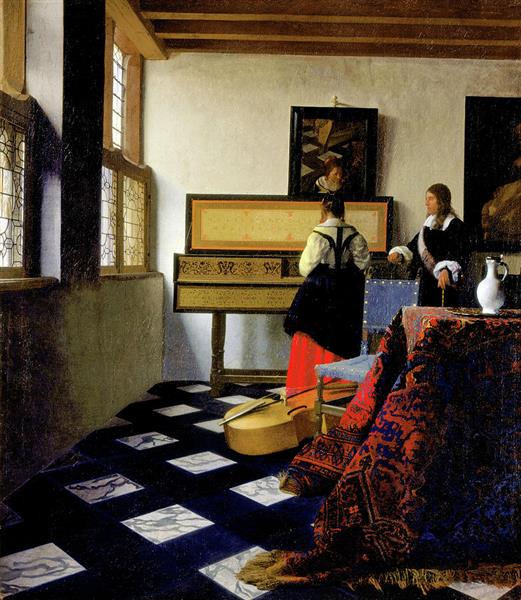
oil, canvas · 1665
Medium
oil, canvas
Period
Baroque
Held at
Royal Collection (Buckingham Palace), London, UK