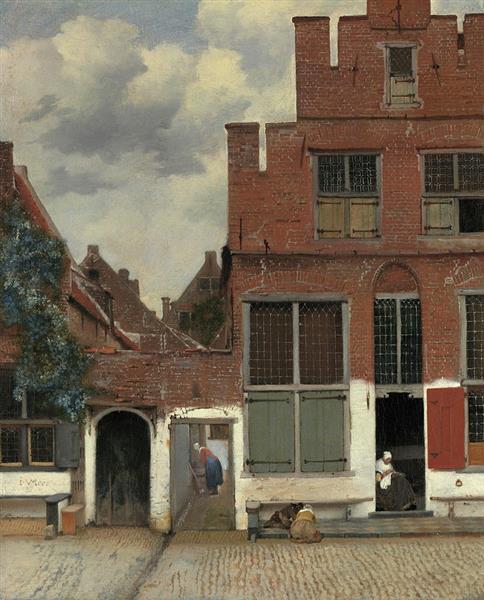
The Little Street
Rijksmuseum, Amsterdam, Netherlands
Johannes Vermeer, 1660
The quiet, unpretentious charm of a Delft street is immediately striking, with figures of women and children engaged in their daily activities. One woman diligently cleans, another does needlework in a doorway, suggesting a focus on domestic virtue. A verdant vine climbing the building on the left hints at love and fidelity, grounding the scene in tradition. This intimate fragment of Vermeer’s hometown, one of only two recognized townscapes by the artist, also reveals a clever compositional strategy. Notice the doorway where the woman works; it’s not perfectly aligned with the building's center. Vermeer seemingly adjusted this to include the vibrant red shutter and part of a window, creating a subtle sense of completion and balance. This technique, possibly influenced by his contemporary Pieter De Hooch, shows a deliberate crafting of space. New research points to Vlamingstraat as the likely setting, adding a fascinating personal layer, as Vermeer’s widowed aunt lived in the house on the right, and his mother and sister resided nearby. This makes one wonder if the painting captures more than just a street, but also a personal landscape of memory.
No thoughts yet. Be the first to share one.
TagsBaroqueoilcanvascityscape
3.50 (2 ratings)
oil, canvas · 1660
Medium
oil, canvas
Period
Baroque
Held at
Rijksmuseum, Amsterdam, Netherlands