The Druidess
Private Collection
Odilon Redon, 1893
The Druidess immediately pulls you into a realm of quiet introspection, its forms envisioned as emerging softly from the charcoal and pastel on paper. Redon, a French artist whose career spanned from 1840 to 1916, was deeply involved with Symbolism, a movement that valued dreams and imagination over direct representation. This particular work from 1893, crafted in charcoal, paper, and pastel, likely employed the smudged depths of charcoal to create a shadowy, mysterious figure. One can imagine a solitary woman with an ethereal quality, where pastel would then introduce delicate, hazy tones, hinting at otherworldly light or the subtle colors of nature, giving the druidess a sense of ancient wisdom or spiritual connection. It's fascinating how a title alone can shape our interpretation, inviting us to consider themes of nature, prophecy, and forgotten rituals, even when faced with an almost abstract evocation. The reliance on suggestion rather than explicit depiction, leaving much to the viewer's imagination, remains a hallmark of Redon's enduring Symbolist approach.
No thoughts yet. Be the first to share one.
TagsSymbolismcharcoalpaperpastelportrait
4.00 (2 ratings)
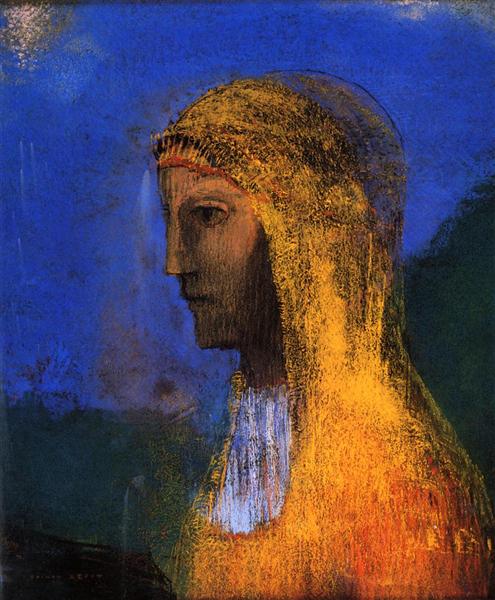
charcoal, paper, pastel · 1893
Medium
charcoal, paper, pastel
Period
Symbolism
Held at
Private Collection