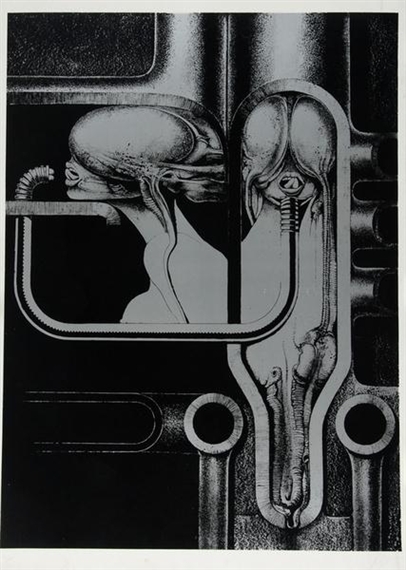
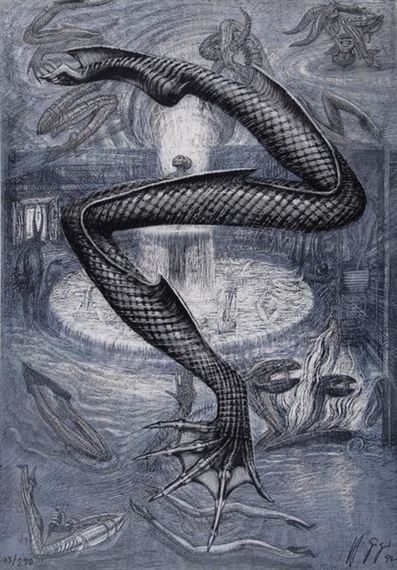
Pisces zinc
H.R. Giger, 1992
The 1992 work "Pisces zinc" by H.R. Giger offers a fascinating conceptual space, particularly when one considers its declared movement, Fantastic Realism. What immediately strikes is the stark simplicity of its listed details. We know the artist, the year, and the genre, yet the medium is explicitly unknown. This absence of material information transforms the artwork into an intellectual puzzle. The title, "Pisces zinc," suggests a fusion of the astrological and the elemental, potentially hinting at a metallic representation of aquatic forms. But without knowing if it's a sculpture, a drawing, or something entirely different, the mind is left to grapple with its potential physicality. Given its classification, Fantastic Realism implies a meticulous, perhaps unsettling, rendition of a dreamlike or fantastical subject. How would Giger's interpretation of "Pisces zinc" manifest these qualities? The very fact that its medium is unrecorded forces us to engage with the piece on a purely speculative level, asking what kind of precise, yet otherworldly, reality this specific combination of title and movement might have brought forth in 1992. The mystery of its tangible form lingers, a compelling question about the unseen.
No thoughts yet. Be the first to share one.
TagsFantastic Realismsymbolic painting
5.00 (1 rating)
1992
Period
Fantastic Realism