Paris Street, Rainy Day
Art Institute of Chicago, Chicago, IL, US
Gustave Caillebotte, 1877
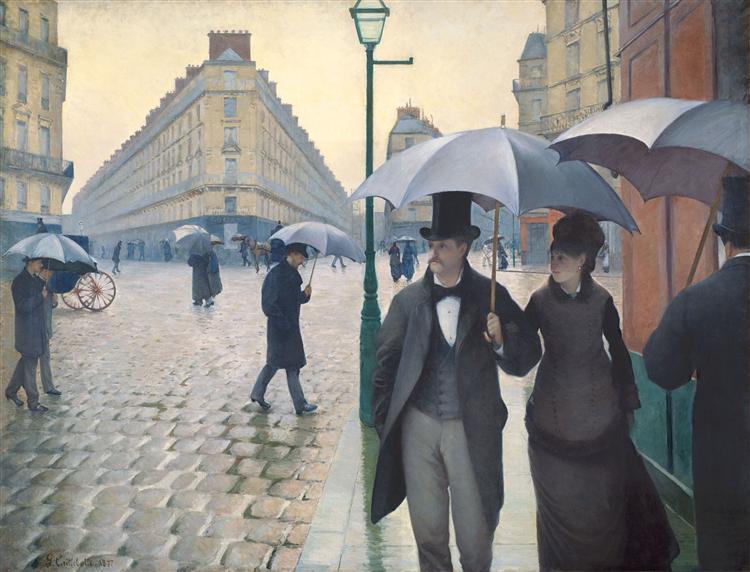
The way the light catches the wet cobblestones in Gustave Caillebotte’s “Paris Street, Rainy Day” instantly draws you into its damp, bustling scene. A perfectly elegant bourgeois couple, almost striding directly at the viewer, dominates the foreground with their distinct attire and opened umbrellas. This monumental artwork, Caillebotte’s largest, presents an intersection of modern Paris with a startling, almost photographic clarity. Unlike the loose brushwork of many Impressionists, Caillebotte uses precise detail, giving the impression of a moment frozen in time. The dramatic cropping of figures, like the man with a ladder in the background or the obscured figures behind the couple, suggests an affinity with the newly popularized medium of photography. It's fascinating to consider that preparatory sketches for this precise perspective might have involved an optical device like a camera lucida, a method artists sometimes concealed due to "anti-artistic" criticism at the time. Caillebotte masterfully portrays the atmosphere of a rainy day not through explicit drops, but through subtle reflections and the practical detail of retractable umbrellas, reflecting the urban transformation of 19th-century Paris. One wonders if Caillebotte, who never again attempted such a multi-figure composition on this scale, ever fully articulated his unique approach.
No thoughts yet. Be the first to share one.
TagsImpressionismoilcanvasgenre painting
4.25 (2 ratings)
oil, canvas · 1877
Medium
oil, canvas
Period
Impressionism
Held at
Art Institute of Chicago, Chicago, IL, US