Nighthawks
Art Institute of Chicago, Chicago, IL, US
Edward Hopper, 1942
Edward Hopper’s Nighthawks, created in 1942, is a renowned oil on canvas masterwork of Modernism. Hopper himself observed he was "unconsciously, probably, painting the loneliness of a large city." The scene unfolds in an all-night diner, where three customers and a server are depicted. Each figure appears lost in their own thoughts, seemingly disengaged from one another, creating an atmosphere of quiet solitude. The composition is remarkably organized with harmonious geometric forms. There's a notable absence of an entrance and street debris, emphasizing the contained, almost imagined world within. The diner’s electric light emits an eerie glow, acting as a beacon against the dark street corner, especially striking as fluorescent lights were new in the early 1940s. A seamless wedge of glass separates the anonymous figures from the viewer, enhancing their remote and uncommunicative nature. This serene, beautiful, yet enigmatic artwork, inspired by a New York restaurant, invites viewers to ponder the relationships and stories within its timeless setting, making it an icon of American culture.
No thoughts yet. Be the first to share one.
TagsSocial Realismoilcanvascityscape
5.00 (5 ratings)
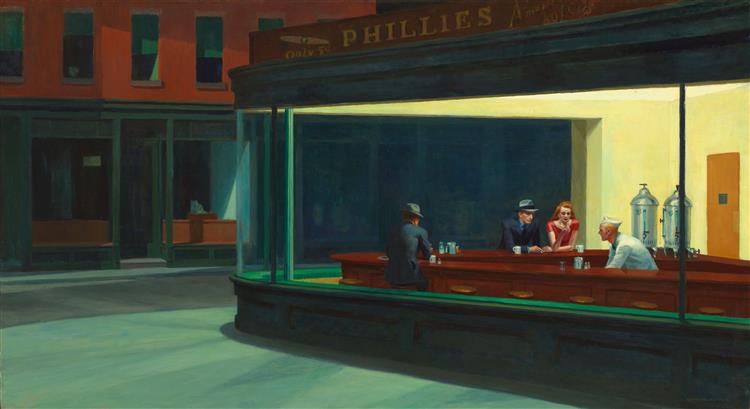
oil, canvas · 1942
Medium
oil, canvas
Period
Social Realism
Held at
Art Institute of Chicago, Chicago, IL, US