Medusa
Uffizi Gallery, Florence, Italy
Caravaggio, 1597
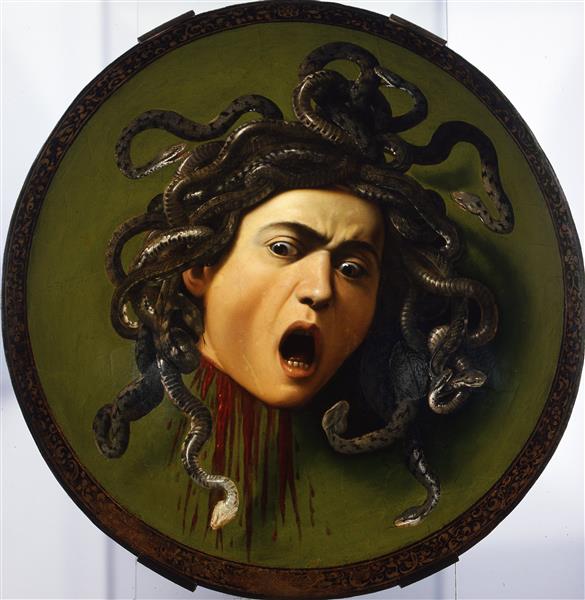
Caravaggio's intense depiction of Medusa brings to life the Greek myth of the Gorgon whose gaze turned observers to stone. Created around 1597 as oil on canvas, this work was commissioned as a ceremonial shield by Cardinal Francesco Maria Del Monte for the Medici family, symbolizing the Grand Duke of Tuscany's courage in defeating his enemies. Although Medusa is decapitated, Caravaggio portrays her with vivid consciousness, her wide-open mouth fixed in a dramatic, silent scream. Shocked eyes and a furrowed brow convey a profound sense of disbelief, as if her invincibility had just been shattered. The artist, a master of the Baroque and Tenebrism movements, famously modeled himself for Medusa's face, a clever choice given the myth states Perseus used a mirrored shield to avoid her deadly gaze. He masterfully manipulates the convex surface of the shield to appear concave, making the head seem to project outwards. Rather than scaring the viewer, Medusa's gaze is directed away, transferring the power to us and emphasizing her tragic demise.
No thoughts yet. Be the first to share one.
TagsBaroqueTenebrismoilcanvasmythological painting
4.20 (5 ratings)
oil, canvas · 1597
Medium
oil, canvas
Period
Baroque · Tenebrism
Held at
Uffizi Gallery, Florence, Italy