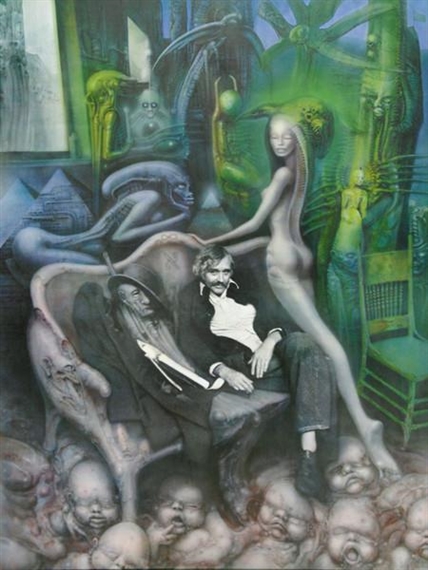
Friedrich Kuhn
H.R. Giger, 1973
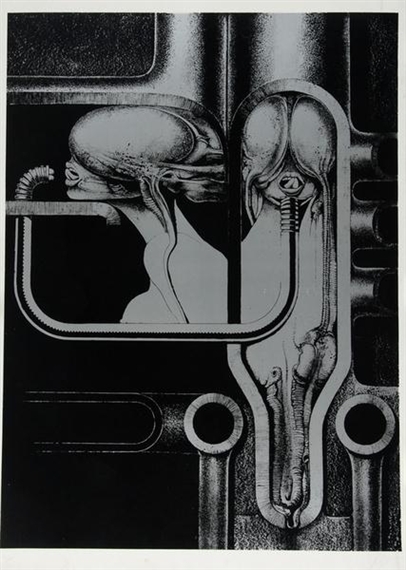
The mere mention of H.R. Giger's "Friedrich Kuhn" from 1973, categorized under Fantastic Realism, immediately conjures a world far removed from typical representations. This movement, by its very nature, challenges the viewer to confront unsettling realities and dream-like distortions. Given Giger's established aesthetic, one can only speculate on the forms this piece might take: perhaps a fusion of organic and machine elements, or intricate, almost biological structures rendered with a chilling precision. The fact that the medium remains "unknown" only amplifies the enigma, preventing any assumptions about its texture or luminosity. It leaves us to ponder whether it was crafted with airbrush, a favored tool for his smooth, alien surfaces, or through some other, more unconventional means that only deepen its mystique. The very absence of concrete visual details forces a deeper engagement with the concept of Fantastic Realism itself, compelling us to imagine the unsettling beauty or profound unease that such a collaboration of artist and movement would produce. What kind of internal landscape did Giger manifest in 1973 with this title, and how did it stretch the boundaries of the real?
No thoughts yet. Be the first to share one.
TagsFantastic Realismportrait
5.00 (1 rating)
1973
Period
Fantastic Realism