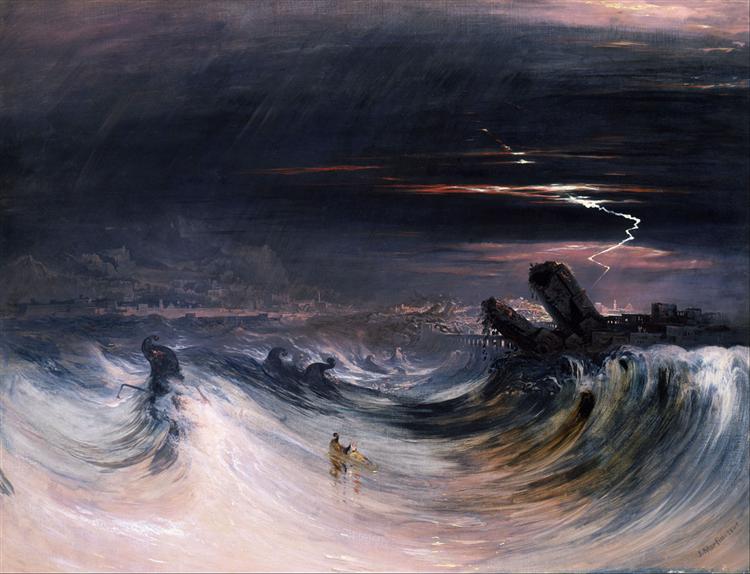
Destruction of Tyre
Toledo Museum of Art, Toledo, OH, US
John Martin, 1840
The air must be thick with smoke and despair in John Martin's 1840 depiction, a work steeped in Romanticism. One imagines colossal waves crashing against ancient walls, already weakened by an unseen cataclysm. There would be a relentless storm of destruction, painting the sky with fiery reds and ominous greys, a stark contrast to the silver gleam of a tetradrachm minted in Tyre centuries earlier. That coin, from 130-129 BCE, portrays Demetrius II Nikator of Syria, an eagle on its reverse – a relic of a city once vibrant, now envisioned in its final, chaotic moments. Martin likely envisioned collapsing structures, perhaps a desperate struggle against overwhelming odds, all rendered with a dramatic scale characteristic of the movement. This piece captures not just a physical demolition but the crushing weight of fate, transforming a once-proud city, famed enough to mint its own currency, into a monumental ruin. What remains after such an event, beyond echoes of ancient coinage and a painter's grim vision?
No thoughts yet. Be the first to share one.
TagsRomanticismreligious painting
5.00 (1 rating)
1840
Period
Romanticism
Held at
Toledo Museum of Art, Toledo, OH, US