The basket of apples
Art Institute of Chicago, Chicago, IL, US
Paul Cézanne, 1895
Paul Cézanne, often considered an "odd man out" among his Impressionist peers, revolutionized the traditional "nature morte" genre with captivating still lifes that continue to "puzzle and tantalize." This significant artwork, the first of his to enter the museum's collection, initially presents as a fruit-laden table setting anchored by a wine bottle. Yet, closer looking reveals Cézanne's "controlled chaos": a misaligned tabletop, a tilted bottle, cascading apples, and a precarious tower of langues de chat cookies that magically stop just short of falling. What truly makes it notable is the disjointment of perspective, as if different parts were seen from varying viewpoints. For example, the right side of the table does not align with the left. This was a deliberate, stylized method Cézanne used to incorporate diverse perspectives into an Impressionistic still life, a technique that helped bridge the gap between Impressionism and Cubism, which later embraced multiple angles. His brushwork varies too, from thick strokes modeling fruits to sketch-like marks around edges. Cézanne rarely signed his paintings, so the signature at the bottom left suggests the importance he ascribed to the piece or its original owner, showcasing his deep engagement with the complexities of visual perception.
No thoughts yet. Be the first to share one.
TagsPost-Impressionismoilcanvasstill life
2.75 (10 ratings)
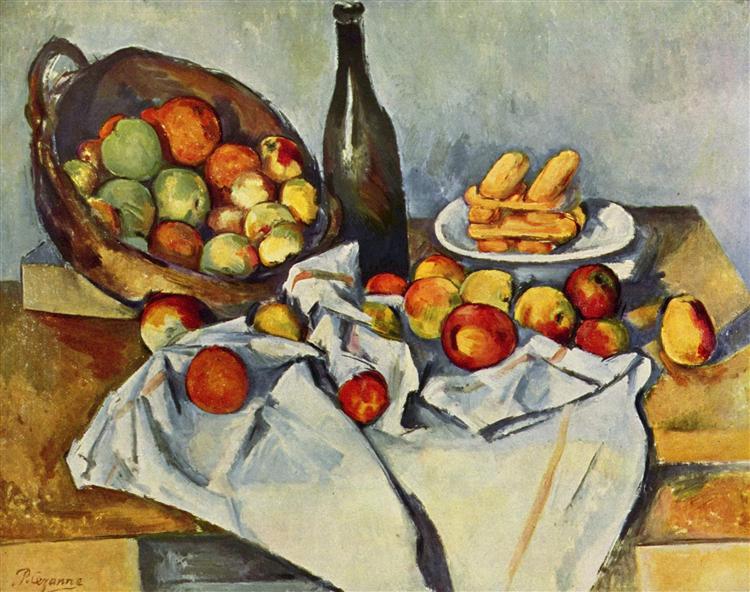
oil, canvas · 1895
Medium
oil, canvas
Period
Post-Impressionism
Held at
Art Institute of Chicago, Chicago, IL, US