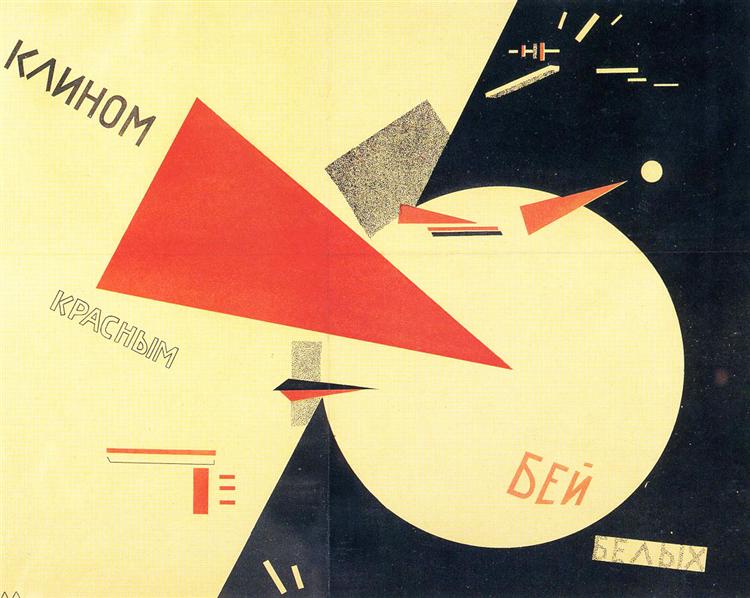
Beat the Whites with the Red Wedge
Lissitzky El, 1920
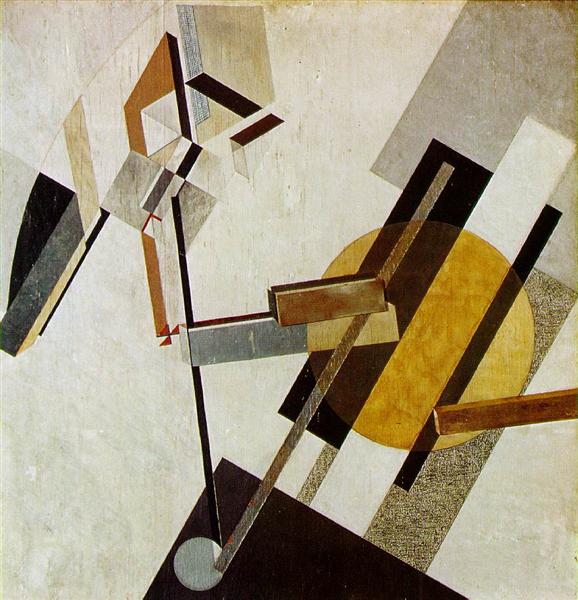
This impactful work by El Lissitzky, created in 1920, is a striking example of propagandistic art from the Suprematism movement. Executed as a lithography on paper, it is deeply politically charged, supporting the Red Army in the aftermath of the 1917 Bolshevik revolution. The artist masterfully employs a signature coded combination of red, white, and black, where colors and shapes carry direct symbolic weight. A vivid red wedge, symbolizing the revolutionaries, dramatically pierces the smooth, curvilinear walls of a white circle, representing the anti-Communist White Army's defenses. This dynamic interplay of forms creates a sense of spatial confusion, blurring the lines between positive and negative areas. Small geometric shapes, resembling tiny projectiles, float through the composition, accompanied by actual text, showcasing a powerful fusion of basic forms and typography. This piece is considered an important precursor to Lissitzky's Prouns, hinting at the evolution of Suprematist art into a three-dimensional visual plane.
No thoughts yet. Be the first to share one.
TagsSuprematismlithographypaperposter
4.50 (1 rating)
lithography, paper · 1920
Medium
lithography, paper
Period
Suprematism